
10 Tips for Buying Aluminium Extrusion Profiles

Time:2026-10-19 Author:Liam
0%

Buying Aluminium Extrusions Profiles is not simply a matter of choosing a shape from a catalogue. The profile must fit your load requirements, joining method, surface expectations, and production budget. A window frame, machine guard, and heat sink demand very different decisions. Small errors can create large costs later.

Professor Michael F. Ashby, a leading materials-selection expert, wrote, “Materials are the stuff of design.” His observation applies directly to aluminium extrusion purchasing. Alloy choice affects strength, corrosion resistance, machinability, and finishing quality. Wall thickness influences both performance and die cost. Even a beautiful profile may fail if its tolerances are unrealistic.

This guide, “10 Tips for Buying Aluminium Extrusion Profiles,” focuses on practical decisions before you contact a supplier. It examines alloy grades, temper conditions, profile dimensions, die design, tolerances, surface treatment, minimum order quantities, inspection documents, packaging, and delivery planning. Expect clear questions, not effortless answers. Real projects often involve compromises. A cheaper die may limit future revisions. A thicker wall may improve rigidity but increase weight. A polished finish may expose scratches that anodizing would hide.

Measure twice.

Reliable sourcing also requires evidence. Request technical drawings, material certificates, inspection records, and clearly defined acceptance criteria. Compare suppliers by process control, communication, and consistency, rather than price alone. The best purchase is rarely the cheapest quotation. It is the profile that performs reliably, arrives protected, and remains practical to manufacture. Mistakes still happen. Careful preparation only makes them less expensive.
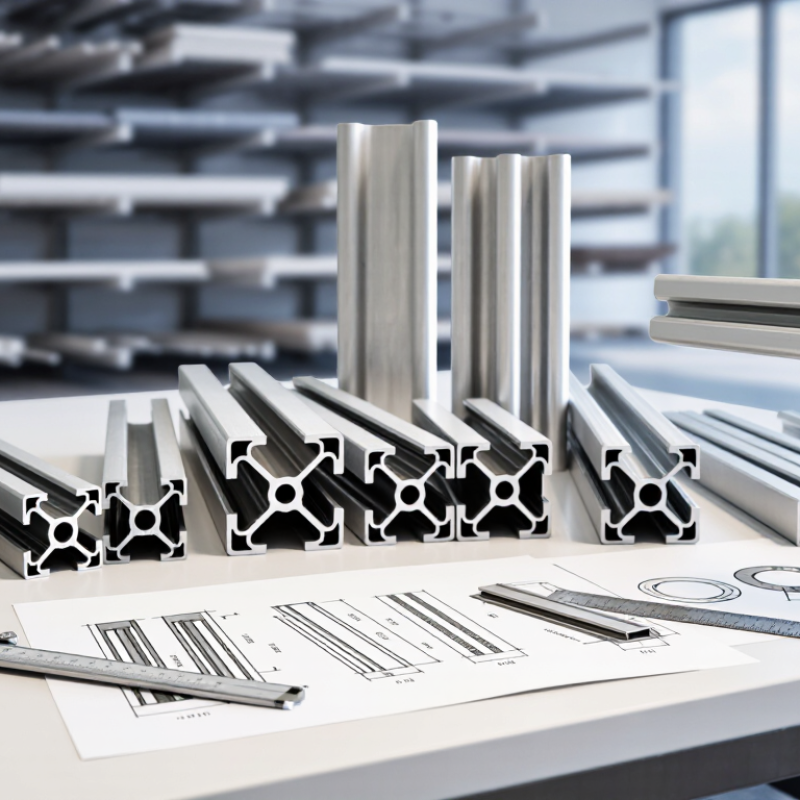
10 Tips for Buying Aluminium Extrusion Profiles

Define Your Aluminium Extrusion Profile Requirements

Before requesting quotations, define the profile’s job, not just its shape. Record load, span, joining method, surface exposure, and installation temperature. A drawing should show critical dimensions, allowable tolerance, alloy, temper, and cut length. Small omissions become expensive. ASTM B221 and ISO 6362-3 provide useful references for extrusion properties and dimensional tolerances. Use them when writing the specification. In practice, I mark inspection points directly on the drawing: wall thickness, twist, straightness, and hole position. This makes a first-article report easier to verify.

Choose the alloy from performance needs. 6063 is often selected for architectural finish, while 6061 generally suits higher structural demand. Actual strength still depends on temper and section geometry. Do not copy a familiar alloy without checking calculations. The International Aluminium Institute reported global primary aluminium production of about 70.6 million tonnes in 2023. That volume indicates a broad supply base, not automatic consistency. Ask for material certificates, temper records, surface-finish limits, and sample measurements. Define packaging too: protective film, separators, bundle length, and moisture control. One awkward detail matters. Specify whether tolerance applies before or after anodizing. I have seen acceptable profiles fail because that point was never agreed. Leave room for revision after prototype testing; real assemblies expose assumptions that drawings hide.

Choose the Appropriate Aluminium Alloy and Temper

Choosing the Appropriate Aluminium Alloy and Temper

Selecting an aluminium extrusion profile starts with the alloy, not the shape. The alloy affects strength, corrosion resistance, machinability, surface finish, and cost. For decorative frames, light enclosures, and indoor structures, 6063 alloy often provides smooth surfaces and dependable extrusion performance. Its appearance is excellent. For brackets, machine parts, and load-bearing components, 6061 may offer higher strength and better machining results.

Temper is equally important. It describes how the alloy was strengthened after extrusion. T5 profiles are cooled after extrusion and artificially aged, giving useful strength with good dimensional stability. T6 material receives additional solution heat treatment and aging, producing higher strength. However, stronger is not always better. A T6 profile may be less forgiving during bending, drilling, or tight assembly.

Check the actual working conditions before ordering. Consider load direction, span length, temperature, moisture, fasteners, and required surface treatment. Ask for a material certificate and verify the alloy and temper markings. A small sample can reveal warping, surface defects, or unexpected machining behavior.

Do not rely only on a catalog value. Real performance depends on profile geometry and wall thickness.

I once underestimated joint movement in a lightweight frame; the alloy was suitable, but the connection design was not. That mistake still influences my specification process.

Allow a safety margin, but avoid paying for strength that the application cannot use.

Evaluate Profile Dimensions, Tolerances, and Surface Finish

10 Tips for Buying Aluminium Extrusion Profiles

Evaluate Profile Dimensions, Tolerances, and Surface Finish

Start with the finished assembly, not the catalogue sketch. Confirm width, height, wall thickness, slot size, and overall length. A two-millimetre error can prevent brackets from seating correctly. Request a dimensioned drawing with critical measurements clearly marked. Do not assume every listed dimension has the same tolerance.

Tolerances should match the function. A decorative cover may accept wider variation than a sliding guide or structural frame. Ask how straightness, twisting, cut length, and hole positions are inspected. For long profiles, thermal expansion also matters during production and installation. Measure samples with calibrated tools, and record the results. Measure twice.

Surface finish needs equal attention. Specify anodized, powder-coated, mill-finished, or another suitable treatment. Describe the required colour, gloss level, coating thickness, and visible-face standard. Inspect the profile under bright, angled light. Small scratches, die lines, or colour shifts may appear after cutting. Cut ends can also look rough, even when the main surface appears excellent.

I once treated finish consistency as a cosmetic issue. That was a mistake. Adjacent profiles showed different tones under office lighting. Approve a physical sample before placing a large order. Keep the approved sample, inspection report, and packaging requirements together. Some suppliers provide excellent surfaces but inconsistent dimensions. Others meet dimensions while overlooking handling marks. Define acceptance criteria before production begins.

Compare Suppliers, Manufacturing Processes, and Quality Standards

When buying aluminium extrusion profiles, compare suppliers on evidence, not polished brochures. Request mill certificates, die-design records, inspection plans, and traceability from billet to shipment. An experienced buyer should also ask about minimum order quantities, die charges, lead times, and corrective-action history. Cheap quotes often exclude packaging or secondary machining. That omission matters.

Industry reports show why process choices deserve attention. The International Aluminium Institute reported about 70.6 million tonnes of global primary aluminium production in 2023. It also states that recycling uses roughly 5% of the energy required for primary aluminium production. Ask suppliers to separate verified recycled content from unsupported environmental claims. Compare direct, indirect, and hydrostatic extrusion. Direct extrusion suits many standard sections, but billet friction can increase die wear. Indirect extrusion may improve dimensional consistency for some alloys, although tooling costs can rise. For 6063 or 6061 profiles, request temper, extrusion speed, quenching, aging, and straightening details. Small process differences can change hardness and bow.

Quality should be measurable. Specify EN 755 or ASTM B221 where applicable, then define tolerances using the relevant product standard. Request chemical analysis, tensile results, dimensional reports, surface inspection, and anodizing thickness records. ISO 9001 certification supports controlled systems, but it does not guarantee a perfect profile. I have seen compliant paperwork fail to reveal inconsistent packing damage. Inspect sample bundles, corner protection, label accuracy, and cut-end condition before approving volume production. Also ask how rejected profiles are segregated, recorded, and replaced. Some suppliers answer slowly. That is useful evidence too.

10 Tips for Buying Aluminium Extrusion Profiles

Compare suppliers by alloy, temper, manufacturing process, inspection capability, certifications, lead time, and traceability. The chart shows representative minimum tensile-strength and proof-stress values commonly specified for several extruded aluminium alloys in the T5 and T6 tempers. Exact requirements depend on section thickness and the applicable standard.

Reference basis: commonly specified mechanical-property values associated with EN 755-2 and ISO 6362-2 aluminium extrusion requirements. Always request the supplier’s material certificate and verify the exact alloy, temper, wall thickness, and testing standard.

Practical Supplier-Comparison Checklist

  1. Confirm the alloy and temper, such as 6063-T5 for finish quality or 6061-T6 for higher strength.
  2. Check whether the supplier follows a suitable extrusion standard, including EN 755, EN 12020, ASTM B221, or ISO 6362.
  3. Review billet sourcing, chemical-composition control, and heat-treatment records.
  4. Compare die-design capability, profile complexity, minimum wall thickness, and dimensional tolerances.
  5. Request inspection reports covering dimensions, surface finish, straightness, hardness, and mechanical properties.
  6. Require heat numbers, lot identification, and full material traceability.
  7. Evaluate anodizing, powder coating, polishing, cutting, machining, and other secondary-process controls.
  8. Verify production capacity, tooling lead time, minimum order quantity, and repeat-order consistency.
  9. Inspect packaging methods to prevent scratches, distortion, moisture damage, and mixed-lot shipment.
  10. Approve samples before mass production and define acceptance criteria in the purchase specification.

Review Pricing, Lead Times, Packaging, and Delivery Terms

When buying aluminium extrusion profiles, compare the complete landed cost, not only the price per kilogram. The International Aluminium Institute reported 72.3 million tonnes of primary aluminium production in 2024. Energy, billet availability, alloy, and surface treatment still influence quotations. Ask suppliers to separate billet, die, extrusion, anodizing, machining, packaging, and freight charges. Small extras can become expensive.

Lead times need similar precision. Request separate dates for die design, die production, sample approval, mass production, and dispatch. A practical quotation should show production days and a realistic transport buffer. UNCTAD’s Review of Maritime Transport reports that ships carry over 80% of global merchandise trade by volume. Port congestion can therefore disrupt an otherwise ready order. I once treated a quoted lead time as a fixed promise. That was careless.

Packaging deserves inspection. Profiles should use dry separators, edge protection, strong bundles, and clear length labels. For anodized surfaces, protective film may reduce scratches, but trapped moisture can create stains. Ask for bundle weight, maximum length, and loading photographs. Delivery terms must also be written clearly. Under Incoterms, responsibility for freight, insurance, customs, and risk changes with the selected term. Confirm the exact named place, not merely “delivered.” It matters. Allow a contingency for rejected samples or damaged bundles, because perfect schedules rarely survive real handling.

FAQS

What details should a drawing include before requesting an aluminium extrusion quotation?

Include critical dimensions, tolerances, alloy, temper, cut length, wall thickness, and hole positions. Mark inspection points directly on the drawing. Small omissions become expensive.

How should the profile’s application affect the material choice?

Define the load, span, joining method, temperature, and surface exposure. Architectural finishes often suit 6063 alloy. Higher structural demand may suit 6061 alloy, depending on calculations.

Does the alloy alone determine profile strength?

No. Temper and section geometry also affect strength. Do not copy a familiar alloy without checking the actual design loads. That shortcut may be wrong.

What supplier documents should buyers request?

Request material certificates, temper records, chemical analysis, tensile results, and dimensional reports. Traceability should cover billet, production, inspection, and shipment. Paperwork still needs checking.

Which manufacturing details can affect profile consistency?

Ask about extrusion direction, tooling design, extrusion speed, quenching, aging, and straightening. These details can change hardness, bow, and final dimensions. Small process differences matter.

How can buyers compare supplier quotations fairly?

Compare die charges, minimum quantities, lead times, packaging, machining, and replacement terms. A cheap quote may exclude protective film or separators. Read the omissions.

What packaging requirements help prevent aluminium profile damage?

Specify protective film, separators, bundle length, corner protection, labels, and moisture control. Inspect cut ends and bundle condition before volume approval. Packing damage can hide under clean paperwork.

Should anodizing change the agreed dimensional tolerance?

State whether tolerance applies before or after surface treatment. Also request coating thickness records and sample measurements. This point is easy to miss, unfortunately.

What should happen after prototype testing?

Keep room for drawing revisions after assembly trials. Real joints may reveal bow, hole misalignment, or fit problems. Drawings hide assumptions sometimes.

Conclusion

Buying Aluminium Extrusions Profiles requires careful planning to ensure the final products meet both technical and commercial expectations. Start by defining the profile’s purpose, load requirements, dimensions, shape, and expected operating conditions. Then select an appropriate aluminium alloy and temper based on strength, corrosion resistance, flexibility, machinability, and appearance. It is also important to review dimensional tolerances and surface finish requirements, especially when profiles must fit precisely with other components or remain visible in the final product.

When comparing suppliers, consider their extrusion capabilities, tooling experience, manufacturing processes, inspection procedures, and applicable quality standards. Request clear information about sample approval, production consistency, and documentation before placing an order. Pricing should be evaluated together with tooling costs, minimum order quantities, lead times, packaging methods, and delivery terms rather than viewed as a single figure. A reliable purchasing decision balances performance, quality, production capacity, communication, and total cost, helping reduce delays and ensuring the profiles are suitable for their intended application.

Liam

Liam

Liam is a dedicated marketing professional with a profound expertise in the industry, where he excels at highlighting the unique advantages of our core products. With a keen understanding of market trends and consumer needs, Liam frequently updates our company’s professional blog, providing......