Choosing the right Aluminium Sections begins with more than comparing dimensions, finishes, and prices.
Global buyers now evaluate weight, strength, recyclability, machining needs, and delivery reliability together. The International Aluminium Institute reported global primary aluminium production above 72 million tonnes in 2024. That scale reflects aluminium’s central role in transport, construction, renewable energy, and industrial equipment. Yet volume does not guarantee a suitable profile.
The World Bank’s Commodity Markets Outlook has repeatedly identified aluminium as a strategically important industrial metal, influenced by energy costs and infrastructure investment. Meanwhile, the European Aluminium industry continues to promote closed-loop recycling and lower-carbon production. These trends affect purchasing decisions directly. A lower-cost section may create higher expenses through excessive scrap, weak tolerances, or difficult assembly.
As extrusion specialist Dr. Stephen F. Cotton explains, “Profile design is where aluminium performance becomes practical value.” The principle is simple. Design matters first.
This guide examines ten widely used Aluminium Sections, including angles, channels, T-sections, I-beams, box profiles, and custom extrusions. Each type serves a different purpose. A square tube may support a machine frame, while a slotted profile can simplify modular assembly. Surface finish also matters when profiles face fingerprints, moisture, or outdoor exposure.
Standards such as ASTM B221 and EN 755 provide useful reference points for dimensions, alloys, and tolerances. Still, standards cannot replace application testing. That is the uncomfortable part. Buyers must question catalogue assumptions, verify mill certificates, and review actual loading conditions before approval. Reliable sourcing is not merely a price exercise; it is a traceable engineering decision.
Aluminium Sections Explained: Alloys 6063 and 6061 in Global Trade
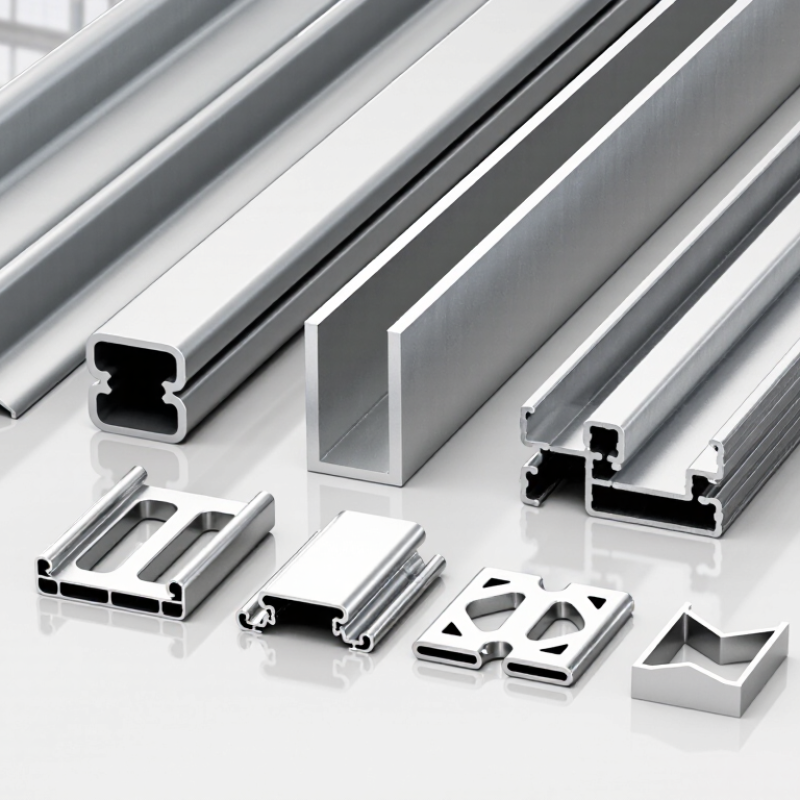
Aluminium sections are widely traded as angles, channels, tubes, flat bars, T-slots, beams, frames, rails, and custom profiles. For global buyers, alloy selection matters more than profile appearance. Alloy 6063 is common for architectural frames, doors, windows, and decorative sections. It extrudes smoothly and accepts anodized finishes well. Its surface can look clean under bright lighting.
Alloy 6061 offers higher strength and better machinability. It suits structural brackets, machine frames, transport components, and load-bearing assemblies. However, it may require more careful extrusion planning and finishing control. In practice, no alloy wins every project. A profile that seems strong enough may still fail under vibration, heat, or repeated loading. Buyers should confirm temper, dimensional tolerances, wall thickness, surface treatment, and mechanical test data before ordering. Country-specific documentation may also affect customs clearance and quality approval.
Tips: Request a trial sample and inspect corners, weld zones, and coating consistency. Compare the specified alloy with the delivered material certificate. Check bundle protection, labeling, and moisture control during shipping. Small details matter. One practical lesson is often missed: reducing wall thickness can lower cost, but it may increase bending, distortion, and installation time. Clear drawings and realistic tolerances usually prevent expensive revisions.
How Extrusion Works: EN 755, EN 12020, and ISO 6362 Standards
Top 10 Types of Aluminium Sections for Global Buyers
Aluminium extrusion begins with a heated billet, usually around 450–500°C. A hydraulic ram presses it through a shaped steel die. The emerging profile may resemble a channel, tube, angle, rail, or complex frame section. A puller controls its speed, while cooling and stretching help reduce distortion. The profile is then cut, inspected, and sometimes artificially aged for higher strength.
EN 755 is widely used for general extruded aluminium products. It covers delivery conditions, mechanical properties, dimensions, and tolerances across relevant product forms. Buyers should check the exact part of the standard, especially for profile tolerances and temper requirements. EN 12020 addresses precision extruded profiles, commonly produced from aluminium alloys such as EN AW-6060 and EN AW-6063. Its dimensional controls are tighter in many applications, including visible frame systems and fitted assemblies. Small deviations matter here.
ISO 6362 provides an international framework for wrought aluminium and aluminium alloy extrusions. It supports clearer communication when suppliers and buyers work across different regions. Still, a standard reference alone is not enough. Specify alloy, temper, wall thickness, straightness, surface condition, cut length, and inspection method. A drawing can miss practical details. We have seen profiles pass a basic dimensional check yet fail during assembly because corner radii or twist were not defined. Standards reduce ambiguity, but they cannot replace a clear specification and measured samples. Some projects need both EN and ISO references, which can create confusion if their limits are not compared carefully.
The Top 10 Aluminium Section Types by Use, Shape, and Market Demand
Global buyers commonly source ten aluminium section types: equal angles, unequal angles, U-channels, C-channels, T-sections, I-beams, square hollow sections, rectangular hollow sections, round tubes, and Z-sections. Each shape answers a different engineering need. Equal angles support frames and brackets. Unequal angles suit offset loads. U- and C-channels guide panels, rails, and machine guards. T-sections connect surfaces with a clean, low-profile joint.
I-beams remain useful where stiffness matters, although they are less common than steel alternatives in heavy structures. Square and rectangular hollow sections provide strong, lightweight frames for doors, partitions, solar supports, and transport equipment. Round tubes are widely requested for handrails, furniture, pneumatic systems, and fluid movement. Z-sections often appear in roofing and facade support systems. Demand changes by region, construction activity, energy projects, and local fabrication skills.
Shape alone does not confirm suitability. Buyers should check alloy grade, temper, wall thickness, straightness, surface finish, and dimensional tolerance. Corrosion exposure also matters, especially near saltwater or industrial fumes. A thin section may reduce weight, but it can complicate welding and fastener placement. A polished surface can look impressive, yet it may hide scratches after cutting. In practice, drawings sometimes ignore thermal movement. That mistake deserves review. Suppliers should provide inspection records, test data, and traceable production details. Clear specifications prevent expensive revisions.
Top 10 Types of Aluminium Sections for Global Buyers - The Top 10 Aluminium Section Types by Use, Shape, and Market Demand
| No. |
Aluminium Section Type |
Typical Cross-Section |
Common Alloys |
Typical Size Range |
Main Applications |
Key Advantages |
Relative Global Demand |
| 1 |
Aluminium Angle |
Equal or unequal L-shaped profile |
6063, 6061, 6082 |
Legs commonly about 10–150 mm; wall thickness about 1–15 mm |
Frames, brackets, edge protection, architectural trim, machinery supports |
Lightweight, easy to cut and drill, good corrosion resistance |
Very High |
| 2 |
Aluminium U-Channel |
Open U-shaped channel |
6063, 6061, 6005A |
Width commonly about 10–200 mm; wall thickness about 1–12 mm |
Sliding tracks, glazing frames, cable covers, machine guarding, structural rails |
Good alignment, low weight, convenient for enclosing or guiding components |
Very High |
| 3 |
Aluminium Rectangular Tube |
Hollow rectangular profile |
6063, 6061, 6063-T5 |
Outer dimensions commonly about 10 × 20 mm to 200 × 400 mm; wall thickness about 1–15 mm |
Vehicle bodies, furniture, solar structures, machine frames, construction assemblies |
Efficient strength-to-weight ratio and broad fabrication compatibility |
Very High |
| 4 |
Aluminium Square Tube |
Hollow square profile |
6063, 6061, 6082 |
Outer dimensions commonly about 10 × 10 mm to 200 × 200 mm; wall thickness about 1–15 mm |
Railings, display systems, furniture, robotics, enclosures and light structures |
Symmetrical geometry, clean appearance and good torsional performance for light-duty frames |
Very High |
| 5 |
Aluminium T-Section |
T-shaped profile with a web and flange |
6063, 6061, 6082 |
Flange width commonly about 10–150 mm; height about 10–150 mm |
Structural stiffeners, partitions, heat sinks, furniture and architectural systems |
Adds directional stiffness while keeping material use relatively low |
High |
| 6 |
Aluminium Round Tube |
Hollow circular profile |
6063, 6061, 6063-T5 |
Outside diameter commonly about 6–250 mm; wall thickness about 0.8–15 mm |
Handrails, fluid lines, bicycle components, furniture, frames and heat-transfer assemblies |
Uniform strength around the circumference, smooth appearance and good formability |
High |
| 7 |
Aluminium Flat Bar |
Solid rectangular strip |
6061, 6063, 6082 |
Width commonly about 10–300 mm; thickness about 2–50 mm |
Base plates, brackets, busbar supports, repair work, architectural details and fabrication |
Simple to machine, weld and fasten; available in many cut-to-length formats |
High |
| 8 |
Aluminium I-Section |
I-shaped beam profile |
6061, 6082, 6005A |
Overall height commonly about 20–300 mm; flange width about 10–150 mm |
Long-span frames, transport equipment, platforms, bridges and engineered structures |
High bending efficiency for applications requiring a lightweight beam |
Medium |
| 9 |
Aluminium Z-Section |
Offset Z-shaped profile |
6063, 6061, 6005A |
Flange width commonly about 15–150 mm; height about 15–150 mm |
Roofing and façade systems, panel edges, solar mounting and offset supports |
Useful for offset connections, overlapping panels and space-efficient assemblies |
Medium |
| 10 |
Aluminium T-Slot Profile |
Modular square or rectangular profile with longitudinal T-slots |
6063-T5, 6061-T6 |
Common series include approximately 20, 30, 40, 45, 50 and 60 mm nominal profiles |
Automation frames, workstations, machine guards, conveyors and modular enclosures |
Fast assembly, adjustable connections and easy reconfiguration without extensive welding |
Medium to High |
Note: Size ranges are indicative and vary by extrusion mill, tooling, alloy, temper, tolerance and applicable regional standards. Relative demand reflects broad international usage across construction, industrial, transport, renewable-energy and fabrication markets rather than audited market-share data.
Comparing Strength, Weight, and Corrosion Data for Global Buyers
Top 10 Types of Aluminium Sections for Global Buyers
For global buyers, strength, weight, and corrosion resistance matter more than shape alone. Aluminium density stays near 2.70 g/cm³, about one-third of steel. Yet alloy and temper change performance greatly. Angles, channels, T-sections, I-sections, box sections, rectangular tubes, round tubes, flat bars, U-sections, and Z-sections serve different load paths.
6063-T5 sections offer clean surfaces and moderate strength. Typical yield strength ranges from 110 to 145 MPa. They suit frames, partitions, and light architectural structures. 6061-T6 sections can reach roughly 240 MPa yield strength. They fit brackets, platforms, and more demanding supports. Hollow box and tube sections reduce weight efficiently. Their closed walls also resist twisting better than many open profiles. However, thin walls may buckle before the alloy reaches its rated strength.
Corrosion data needs careful reading. Aluminium forms a protective oxide film naturally. In dry air, corrosion is often minimal. Salt spray, standing water, and contact with copper can cause pitting or galvanic attack. Anodized surfaces usually improve durability, but damaged areas remain vulnerable. Common exposure rates may range from below 0.01 to around 0.1 mm per year, depending on environment and testing method. That range is broad. A simple ranking can mislead. Engineers should check temper certificates, wall thickness, drainage, fasteners, and actual site exposure. One overlooked joint can weaken an otherwise sound section.
Top 10 Types of Aluminium Sections for Global Buyers
Comparing typical yield strength, material weight, and general atmospheric corrosion resistance
Yield strength and density values represent commonly published ranges for the listed aluminium alloys and tempers used in extruded sections.
The corrosion score is a comparative screening index from 1 to 5, where 5 indicates stronger general atmospheric resistance; it is not a standardized corrosion-test result.
Actual section weight also depends on profile geometry, wall thickness, and cross-sectional area.
Selecting Profiles: Tolerances, Temper Designations, and ASTM References
Top 10 Types of Aluminium Sections for Global Buyers
Selecting an aluminium section requires more than checking its shape and price. Buyers should define dimensional tolerances before approving drawings or samples. ASTM B221 covers many extruded bars, profiles, rods, wires, and tubes. It also provides reference limits for dimensions, straightness, and corner details. Confirm whether the supplier measures at room temperature and uses calibrated tools. Small errors accumulate.
Temper designation affects strength, machinability, and forming performance. F indicates an as-fabricated condition, while O represents annealed material. T5 usually means cooling after extrusion, followed by artificial aging. T6 involves solution heat treatment and artificial aging. T66 may offer higher mechanical properties under controlled processing. Do not select T6 automatically. It can complicate bending and increase springback.
For each profile, request the alloy, temper, applicable ASTM reference, and inspection report. Compare critical dimensions, such as wall thickness, slot width, and outside diameter. A drawing may show ±0.10 mm, but the extrusion standard may allow a different limit. Clarify which requirement controls. In practical sourcing, tolerance tables sometimes look exact but hide measurement assumptions. This is easy to miss. Ask for the inspection method, sampling plan, and lot traceability. A trial order can reveal distortion, die lines, or uneven aging that paperwork cannot show.
FAQS
A billet is heated to about 450–500°C. A hydraulic ram pushes it through a shaped steel die. The profile exits like a channel, tube, angle, or rail. Cooling, stretching, cutting, and inspection follow.
State the alloy, temper, wall thickness, length, straightness, surface condition, and tolerances. Include corner radii, twist limits, and the inspection method. A drawing alone may leave important details unclear.
EN 755 covers general extruded aluminium products, including properties, delivery conditions, and tolerances. EN 12020 focuses on precision profiles with tighter dimensional controls. Small deviations matter in visible frames and fitted assemblies.
ISO 6362 offers a shared framework for wrought aluminium extrusions. It improves communication between suppliers and buyers in different regions. However, the reference does not replace a complete specification.
Wall thickness, slot width, diameter, and straightness can affect fit. Errors may accumulate across several parts. A profile can pass basic inspection yet fail during assembly.
F describes an as-fabricated condition, while O means annealed material. T5 uses cooling after extrusion and artificial aging. T6 includes solution heat treatment and artificial aging. T6 is not always the best choice.
T6 can provide higher strength, but it may complicate bending. It can also increase springback after forming. The strongest option may not suit the final process.
Request measured dimensions, the applicable standard, sampling details, and calibrated equipment information. Include lot traceability and checks for distortion, die lines, and uneven aging. Paperwork can miss practical defects.
Yes, a trial order can reveal twisting, surface lines, or assembly problems. Inspect real samples under the intended production conditions. We may miss this. Small tests often expose weak assumptions.
Conclusion
Aluminium Sections are essential components in construction, manufacturing, transportation, and industrial systems, offering a practical balance of strength, low weight, durability, and corrosion resistance. This guide introduces the widely used 6063 and 6061 alloys, explaining how their chemical and mechanical characteristics influence applications and international purchasing decisions. It also outlines the extrusion process and the importance of EN 755, EN 12020, and ISO 6362 standards in controlling dimensions, surface quality, and production consistency.
The article reviews the top ten aluminium section types according to shape, function, and market demand, including channels, angles, tubes, beams, rails, and customized profiles. Global buyers can compare strength-to-weight performance, corrosion behavior, and expected service conditions before selecting a suitable design. Particular attention is given to dimensional tolerances, temper designations, and relevant ASTM references, helping purchasers evaluate technical specifications, quality requirements, and compatibility with different fabrication and installation processes.